A silver sundial with 26 towns on its back
Butterfield Sundial / 1700s
Why look up a town before reading a clock?
So, what is it?
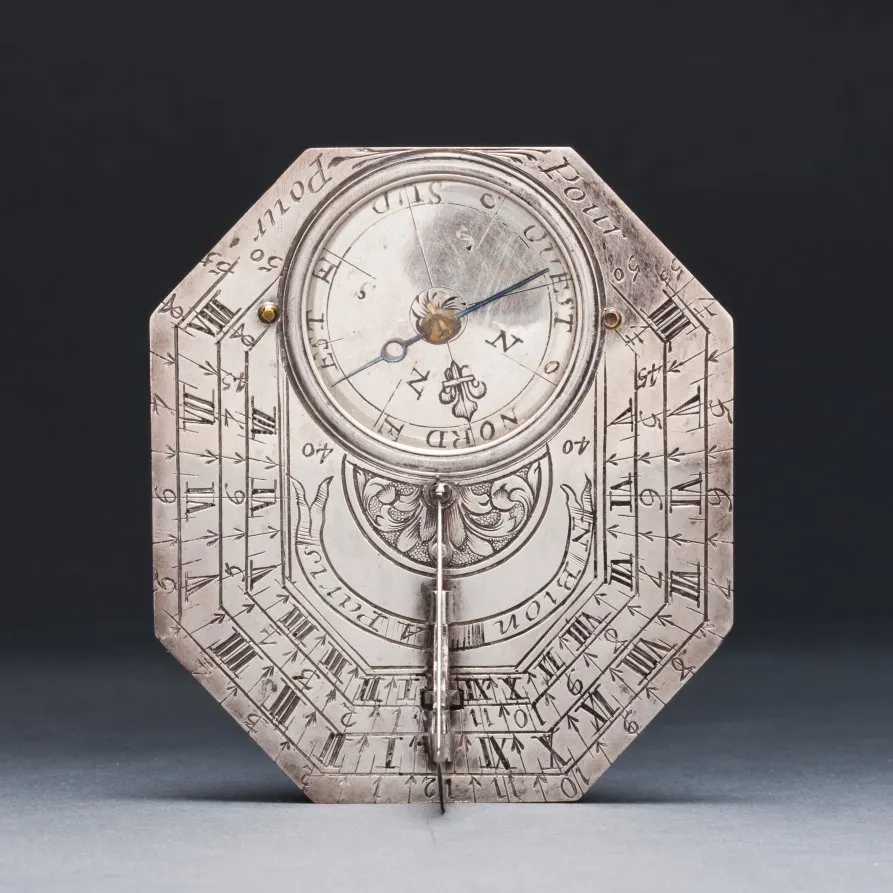
A portable sundial adjusted for latitude to read local time from a shadow.
A closer look
A round compass sits above rows of engraved numerals. Although it fills the photograph, the silver plate measures only 7.7 by 7.4 centimetres. Imagine holding it in one hand on a journey.
The metal fin rising from the dial is its shadow caster, or gnomon. This Butterfield-type dial can be adjusted for latitudes between 40 and 60 degrees north. Latitude matters because travelling north or south changes the height of the sun in the sky.
How would a visitor know the latitude of an unfamiliar town? The museum records a list of 26 European towns and their latitudes on the reverse. One side tells you how to set the instrument before you turn it over to read the time.
Needle and shadow do different jobs
The needle in the circular window gives a direction. It is the shadow of the raised metal fin that points to the time. Once you distinguish orientation, latitude and the position of the shadow, the rows of fine marks look less like decoration and more like decisions a traveller had to make.
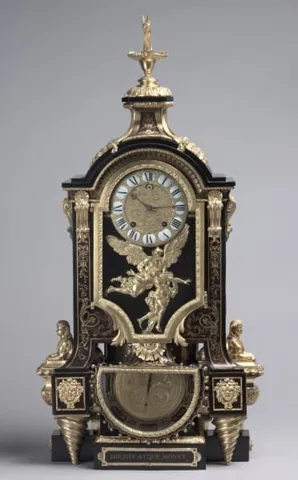
Compare the Boulle clock and barometer
On the Boulle clock, the clock face above and the barometer below report two different quantities. On the portable sundial, compass and hour scale work together towards one reading. Looking at what each indicator measures is more revealing than simply counting the dials.
Explore the comparison → Clock
The observations and comparisons above are editorial interpretation. Object facts are based on these museum records. This object · Comparison object
An editorial summary based on the museum's official records.
A latitude list you could never leave behind!
What would you inspect first on a journey?
Choose the answer that interests you most.
This voting experience is local to this device.
Choices are not shared or counted together with other people's votes.
Object Details
- Official title
- Butterfield Sundial
- Date
- 1700s
- Place
- France
- Collection
- The Cleveland Museum of Art
- Accession number
- 1942.490
- Source
- Official collection page
Gift of Henry W. Kent
The museum's image-use policy
Object-image rights checked: 2026-11-22