A clock with a barometer underneath
Clock / c. 1695
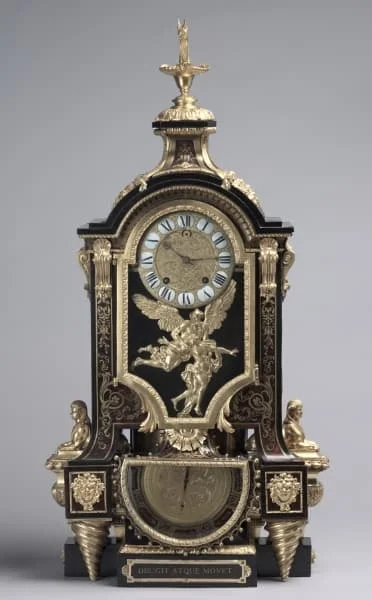
Another window below the clock—what's inside?
So, what is it?
A pendulum clock incorporating a barometer, according to the museum's account.
A closer look
Golden patterns spread across a tall, dark case, with a large round clock face near the top. Move your gaze downward and another instrument appears. A clock and a barometer are built into a single decorative piece of furniture.
Made in France around 1695, the clock is associated in the museum's record with cabinetmaker André-Charles Boulle and clockmaker Balthazar Martinot II. It has a pendulum mechanism, while tortoiseshell and brass inlay, gilt bronze and other materials richly decorate the exterior.
The museum explains that the clock expressed its owner's intellectual interests as well as wealth and status. Notice how time and air pressure—two different kinds of information—are brought together, and the instruments among the ornament become attractions in their own right. The mechanism is described on the basis of historical accounts; its present working condition has not been verified.
Read the two instruments separately
After taking in the gilt ornament, locate the upper dial and the instrument below it. A shared case does not make their information identical: one indicates time and the other air pressure. This distinction helps explain the museum's discussion of intellectual interests. The object also brings together work on a furniture case and work on a clock mechanism.
Furniture that combines functions
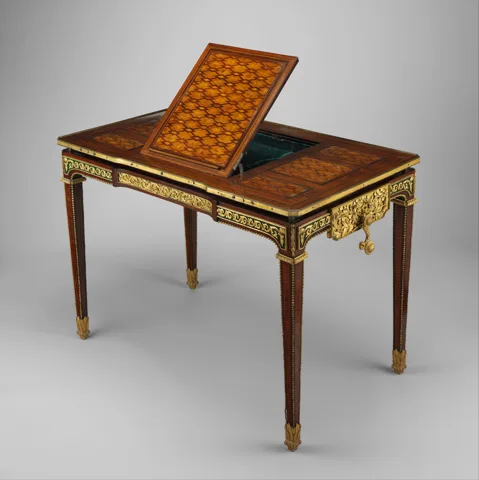
The mechanical table likewise gathers several functions in one furnishing. The clock places instruments together for reading; the table changes height and repositions a central panel for different activities. Our comparison concerns two ways of combining functions, not a shared maker, owner or original room.
Explore the comparison → Mechanical table (Table mécanique)
The observations and comparisons above are editorial interpretation. Object facts are based on these museum records. This object · Comparison object
An editorial summary based on the museum's official records.
Look up, then down. There's a whole clock to explore!
What would you notice first on this clock?
Choose the answer that interests you most.
This voting experience is local to this device.
Choices are not shared or counted together with other people's votes.
Object Details
- Official title
- Clock
- Date
- c. 1695
- Place
- France
- Collection
- The Cleveland Museum of Art
- Accession number
- 1967.153
- Source
- Official collection page
Gift of Family and Friends in honor of Emery May Holden Norweb and Raymond Henry Norweb on their fiftieth wedding anniversary
The museum's image-use policy
Object-image rights checked: 2026-10-11