A clock with roses instead of numbers
Clock / 1908–17
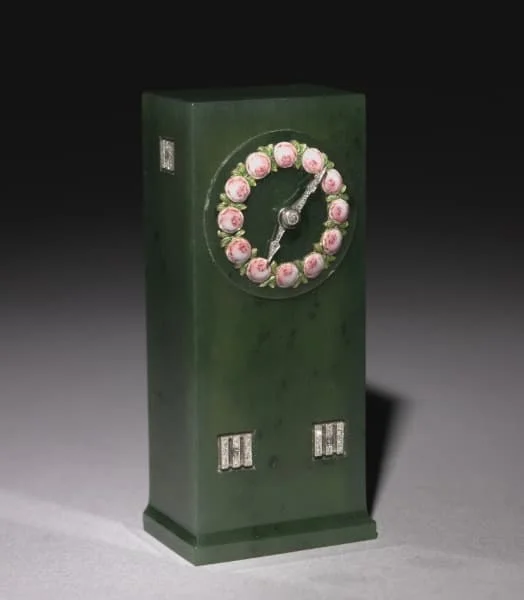
Pink roses are blooming all around the clock!
So, what is it?
A small tabletop clock with enamel roses in the positions normally occupied by numerals.
A closer look
Pink roses form a ring on a small, deep-green clock. At the center are the hands that tell the time. Look closely and the flowers occupy the positions where numbers would normally sit, making a dial as they circle around.
This tabletop clock was made in the Fabergé workshop in Saint Petersburg in 1908–17. The museum records its height as 7.9 centimeters. The green body is nephrite, the roses are enamel, and the hour and minute hands incorporate diamonds. These material descriptions come from the museum's account.
Instead of reading individual numbers, you read the time from the positions of the flowers and the direction of the hands. Follow the flower a hand points toward, and decoration becomes a marker of time. Whether the clock still runs or keeps accurate time has not been verified from the photograph and material reviewed here.
Read flowers as markers
Start at the centre of the hands and trace the positions of the flowers around it. Even without numerals, the relationship between a hand's direction and a marker remains. Our editorial interest lies in the flowers occupying the places used to read the time, rather than an unused border. Material identifications come from the museum record, not from colour alone.
A contrast in scale and information
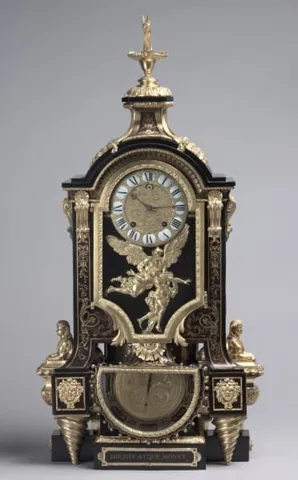
The Boulle clock brings time and air pressure into one ornate furnishing. This clock, only 7.9 centimetres high, concentrates attention on flowers and hands. The comparison concerns how information is presented and framed. It does not tell us which mechanism was more accurate or whether either currently operates.
Explore the comparison → Clock
The observations and comparisons above are editorial interpretation. Object facts are based on these museum records. This object · Comparison object
An editorial summary based on the museum's official records.
I came to check the time. Now I'm studying the roses.
Which part of this clock would you spend the longest looking at?
Choose the answer that interests you most.
This voting experience is local to this device.
Choices are not shared or counted together with other people's votes.
Object Details
- Official title
- Clock
- Date
- 1908–17
- Place
- Saint Petersburg, Russia
- Collection
- The Cleveland Museum of Art
- Accession number
- 1966.475
- Source
- Official collection page
The India Early Minshall Collection
The museum's image-use policy
Object-image rights checked: 2026-10-11