Inside a writing box: tools in their places
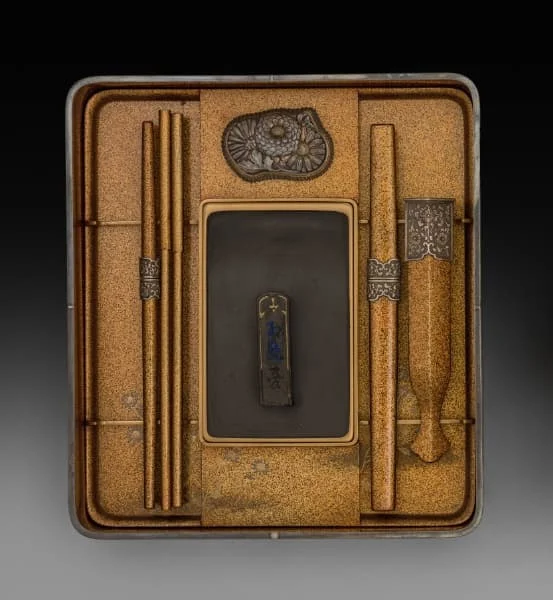
Base of Writing Box (Suzuribako) with Chrysanthemum and Plum Containing Inkstone, Water-dropper, Brushes, Ink-stick Holder, and Paper Knife / late 1800s-early 1900s
All those tools—and each has its own place!
So, what is it?
A writing box for an inkstone, brushes, ink and other tools, paired with a larger box for paper as part of a writing set.
A closer look
A black inkstone sits at the center of the box, with long brushes and other tools arranged on either side. Near the top is a small container with flower-like decoration. The official title also names a water-dropper, a tool for dispensing water a little at a time. This record covers the base of a writing box and its contents; the photograph lets us examine the arrangement inside.
The piece was made in Japan during the Meiji period, in the late 19th to early 20th century. The museum records lacquer on wood decorated with maki-e using gold and silver powders. Holding an inkstone, brushes, ink and other tools, the box forms part of a writing set paired with a larger box for paper.
Long tools and rectangular tools fit into their respective compartments. Compare their shapes with their places, and the thought behind gathering writing tools into one box becomes clear. Decoration inside the lid, which is not visible here, should be considered separately from observations of the base. Nor can we assume that the box was intended to be portable.
Read the arrangement through the tools
Move from the central inkstone to the slender implements beside it. The box becomes more than an empty space: it organizes different shapes as a set. The official title names a water-dropper, brushes and other writing equipment, helping explain that grouping. It does not follow that every small part can be confidently identified from this one photograph.
Compare two kinds of storage
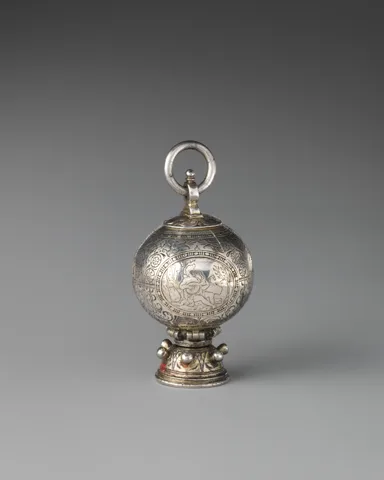
A pomander separates aromatic materials into compartments; this box gathers writing equipment. Both organize contents, but the evidence differs. Here we can inspect an open arrangement, while the pomander's interior must be understood through the museum's description. Comparing both purpose and visibility helps us read the objects more carefully.
Explore the comparison → Pomander
The observations and comparisons above are editorial interpretation. Object facts are based on these museum records. This object · Comparison object
An editorial summary based on the museum's official records.
Maybe my desk needs a place for everything, too.
What would you like to examine in this writing box?
Choose the answer that interests you most.
This voting experience is local to this device.
Choices are not shared or counted together with other people's votes.
Object Details
- Official title
- Base of Writing Box (Suzuribako) with Chrysanthemum and Plum Containing Inkstone, Water-dropper, Brushes, Ink-stick Holder, and Paper Knife
- Date
- late 1800s-early 1900s
- Place
- Japan
- Collection
- The Cleveland Museum of Art
- Accession number
- 1992.389.a
- Source
- Official collection page
Bequest of Maud Eells Corning
The museum's image-use policy
Object-image rights checked: 2026-10-11